
What to Look for in a Horse Boarding Facility: A Complete Guide
Finding the right boarding facility is one of the most important decisions you’ll make for your horse’s wellbeing and your peace of mind. After nearly 20 years of caring for horses at Jaz Creek in Petaluma, we’ve learned what truly matters when choosing where your horse will live. Here’s what to consider.
Start with Safety and Facility Maintenance
Before you consider amenities or location, evaluate the basics: is this facility safe and well-maintained?
Fencing Quality
Walk the property and inspect fencing carefully. Look for:
- No wire fencing in paddocks or pastures (wire can cause catastrophic injuries)
- Proper board fencing or safe no-climb options
- Good repair with no loose boards, protruding nails, or gaps
- Foal-safe fencing if you’ll be breeding or bringing young horses
At Jaz Creek, all our paddocks and pastures feature foal-safe fencing. We’ve eliminated wire completely and maintain our fencing year-round because we know one injury from poor fencing can change a horse’s life forever.
Arena Footing
Quality footing isn’t a luxury—it’s essential for soundness. Poor footing contributes to suspensory injuries, tendon problems, and joint stress.
What to check:
- Is the footing maintained regularly (dragged, watered, leveled)?
- Does it provide proper cushioning without being too deep?
- Is it appropriate for your discipline (jumping footing differs from dressage)?
- Can you ride year-round, or does the arena become unusable in wet weather?
We invested in custom footing blends designed specifically for different uses: GGT premium footing in our 30,000 square foot covered arena and a specialized sand blend in our outdoor jumping arena. Our covered arena means consistent training even during Sonoma County’s rainy season—no more months off waiting for arenas to dry out.
Stall Condition and Ventilation
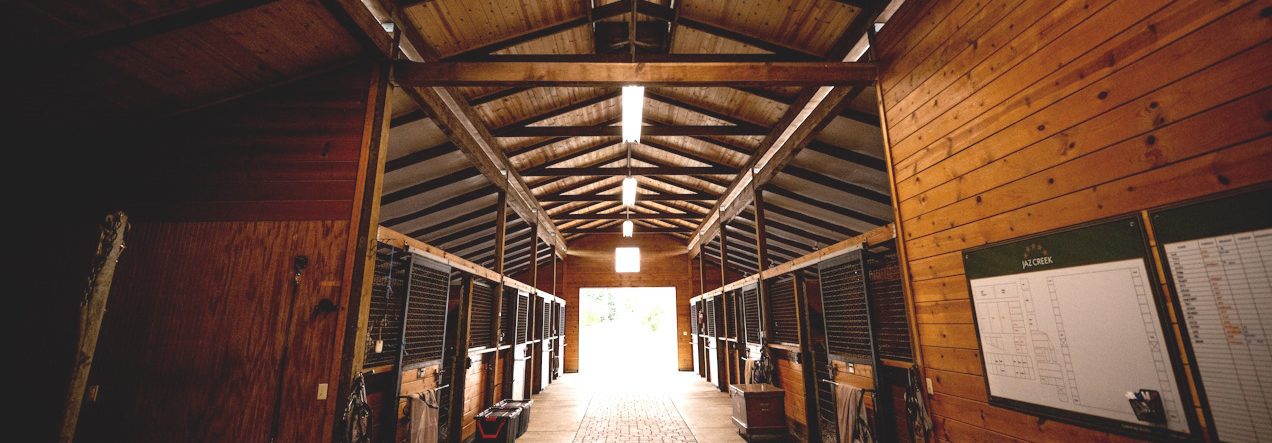
Spend time in the barn. Do stalls smell clean? Is there good air circulation without drafts? Are stalls deeply bedded, or is bedding sparse?
Red flags:
- Strong ammonia smell (indicates inadequate cleaning or ventilation)
- Dusty or moldy hay stored near stalls
- Stalls that are too small for the horses in them
- Automatic waterers that don’t work properly
Our stalls feature automatic waterers that we check daily, ensuring fresh water is always available. We bed properly and clean daily—not just picking stalls but truly cleaning them. The difference in respiratory health and overall comfort is noticeable.
Turnout: More Than Just a Paddock
Turnout philosophy varies widely between facilities, and it should match your horse’s needs.
Turnout Options
Does the facility offer:
- Individual turnout for horses who need solo time?
- Small group turnout for horses with buddies?
- Larger pasture turnout for horses who thrive in herd environments?
- All-weather paddocks that don’t become mud pits in winter?
We provide all these options because different horses need different things. Some competition horses prefer individual turnout where they can relax without herd dynamics. Retirees often love group pasture where they can graze and socialize. Young horses benefit from age-appropriate groups where they learn social skills.
Pasture Management
If grass turnout is important to you, ask:
- How many horses per acre?
- Is pasture rotated to prevent overgrazing?
- Are pastures maintained (mowing, fertilizing, weed control)?
- What happens during wet months when pastures can’t handle turnout?
Our all-weather paddocks ensure horses get outdoor time even during Petaluma’s wet winters. When grass pastures need rest, horses don’t get confined to stalls—they simply rotate to paddocks designed for year-round use.
Quality of Daily Care
The best facilities in the world don’t matter if daily care is inconsistent or rushed.
Feeding Programs
Ask detailed questions:
- How many times per day are horses fed?
- What quality hay is provided?
- Can grain programs be customized for individual horses?
- How are supplements administered?
- What happens if a horse doesn’t eat its meal?
We feed twice daily with premium Timothy and orchard grass hay, and every horse’s grain program is customized. Some horses need weight management; others need extra calories for hard work. We notice when horses don’t finish meals—often the first sign something’s wrong—and alert owners immediately.
Staff Experience and Turnover
High staff turnover is a major red flag. Experienced staff who know the horses make all the difference.
Ask:
- How long has the barn manager been there?
- Do staff members know horses by name and personality?
- Is someone on-site 24/7 for emergencies?
- What’s the staff-to-horse ratio?
At Jaz Creek, our experienced team has been caring for horses for years. We know which horses are food-aggressive and need separate feeding, who’s best friends with whom in turnout, and which horses need extra time to eat grain. This institutional knowledge can’t be replaced, which is why we prioritize retaining excellent staff.
Riding Facilities That Match Your Discipline
Not all arenas are created equal, and what works for one discipline may not suit another.
Covered vs. Outdoor Arenas
In Northern California, a covered arena isn’t just convenient—it’s essential for consistent training.
Benefits of covered arenas:
- Year-round riding regardless of weather
- No seasonal training gaps during rainy months
- Ability to maintain horses in competition condition through winter
- Protection from sun in summer
Our 200′ x 100′ covered arena (30,000 square feet) is one of the largest in the region. It’s enclosed on two sides for weather protection but maintains good ventilation. The size means multiple riders can school simultaneously without crowding, and there’s room for full courses when setting jumps.
Specialized Equipment
For serious training, look for:
- Show-quality jumps (not makeshift poles and barrels)
- Dressage letters and markers if you ride dressage
- Round pen with safe fencing for groundwork
- Trails for fitness and mental breaks from arena work
Our outdoor arena features professional-grade show jumps and custom footing designed specifically for hunter/jumper work. The 165′ x 270′ size accommodates technical courses and allows proper distances for combination lines.
The Eurociser Advantage: A Rare but Valuable Amenity
One feature that’s becoming increasingly important but remains rare is an equine exerciser or Eurociser.
What Is a Eurociser?
A Eurociser is a circular, automated horse walker—but calling it a “walker” undersells its value. Modern Eurocisers like our 68-foot, 5-horse Centaur Free-Flow model are sophisticated conditioning tools.
Why It Matters
If your horse needs:
- Rehabilitation from injury (controlled, consistent exercise at prescribed speeds)
- Fitness maintenance between training sessions
- Conditioning without rider weight
- Mental stimulation when stalled due to weather or injury
- Warm-up or cool-down before/after riding
A facility with a quality Eurociser offers significant advantages. We’re one of the few facilities in Sonoma County—and the broader Bay Area—with this equipment. For horses recovering from suspensory injuries, post-surgical rehab, or maintaining fitness during layup, the Eurociser is invaluable.
Specialized Services Beyond Basic Boarding
Consider what additional services you might need now or in the future.
Training Programs
Does the facility:
- Have professional trainers on-site?
- Welcome outside trainers?
- Offer lessons for your discipline?
- Have school horses if you don’t own?
Through our partnership with Ijula Equestrian for hunter/jumper programs and Alex Greer Dressage for dressage instruction, boarders have access to professional training without trailering elsewhere. We also welcome outside trainers—many serious competitors maintain relationships with specific coaches, and we support those partnerships.
Foaling and Breeding Services
If you breed horses or might in the future, foaling services are crucial but rare.
What to look for:
- Experience with broodmares and foals
- 24-hour monitoring during foaling season
- Foal-safe environment (fencing, turnout, stalls)
- Veterinary relationships for emergencies
We’re one of the few Bay Area facilities offering comprehensive foaling services. Having foaled numerous healthy foals over the years, we have the protocols, facilities, and experience to handle both routine deliveries and complications. Our foal-safe fencing and separate turnout options ensure mares and foals bond safely before integrating with other horses.
Retirement and Senior Horse Care
If your horse is approaching retirement or is already retired, they deserve specialized care.
Key considerations:
- Does the facility welcome retirees, or is it competition-focused only?
- Are there turnout options appropriate for older horses?
- Will staff notice subtle changes in senior horses?
- Can feeding be adjusted for dental issues or weight maintenance?
We love retirees and understand their unique needs. Some older show horses prefer barn living with daily grooming and attention; others thrive in pasture with buddies. We offer both options and tailor care to individual preferences. Many of our retirees are former competition horses who gave their all—they deserve exceptional care in their golden years.
Location and Accessibility
Practical considerations matter more than you might initially think.
Commute Time
Be realistic about how often you’ll visit. A facility 15 minutes away that you visit six times a week is better than a “perfect” facility 45 minutes away that you visit twice a week because the drive is exhausting.
Our Petaluma location offers the best of both worlds: peaceful wine country surroundings with excellent accessibility. We’re 10 minutes from downtown Petaluma and Santa Rosa, under 10 minutes from Rohnert Park, and 15 minutes from Sebastopol. Marin County riders are just 15 minutes south, and even San Francisco is only 45 minutes away. Easy Highway 101 access means trailering to shows is straightforward.
Proximity to Services
Consider access to:
- Veterinarians (especially equine emergency vets)
- Farriers
- Feed stores
- Equine hospitals if specialized care is needed
Sonoma County has excellent equine veterinary services, and we’ve built strong relationships with local vets who know our facility and horses.
Culture and Community
This is often overlooked but profoundly important for your experience.
Barn Atmosphere
Visit during prime times (evenings, weekends) and observe:
- Are boarders friendly and supportive?
- Is there drama, or is the atmosphere professional and positive?
- Do people help each other?
- Are different disciplines respected?
We’ve intentionally cultivated a drama-free, supportive community. Whether you ride dressage, hunters, jumpers, or just enjoy trail riding, you’ll find respect for your goals. Many of our boarders have been with us for years—a testament to the positive environment.
Management Responsiveness
How does management handle concerns?
- Are issues addressed promptly?
- Is communication clear and professional?
- Do they welcome questions and feedback?
- Are policies transparent?
We maintain open communication with all boarders. When issues arise—and they do at any barn—we address them directly and professionally. Transparency builds trust, and trust is essential when you’re entrusting your horse to someone else’s care.
Making Your Decision
After visiting facilities, trust your gut but verify with facts.
The Visit Checklist
During facility tours:
- ✅ Visit unannounced if possible (see day-to-day operations, not just the “show” version)
- ✅ Look at actual horses boarded there (are they healthy, well-groomed, content?)
- ✅ Check water buckets/automatic waterers (are they clean and full?)
- ✅ Inspect hay quality (green, fresh-smelling, not dusty or moldy)
- ✅ Ask to see stalls after morning feeding (how clean are they?)
- ✅ Talk to current boarders (most honest feedback you’ll get)
- ✅ Ask about staff turnover and experience
- ✅ Review contract carefully (what’s included, what costs extra, notice requirements)
Red Flags to Never Ignore
Walk away if you see:
- Thin or obviously unhealthy horses
- Aggressive responses to reasonable questions
- Reluctance to let you visit unannounced or talk to boarders
- Unsafe facilities (wire fencing, poor repair, hazards)
- High boarder turnover (ask how long current boarders have been there)
- Ammonia smell in barns
- Defensive or hostile barn management
The Bottom Line
Choosing a boarding facility is about finding the right fit for both you and your horse. The “best” facility on paper might not be the best for your specific situation.
Prioritize:
- Safety first (fencing, facilities, emergency protocols)
- Quality daily care (experienced staff, good feeding, attentive management)
- Appropriate amenities for your discipline and goals
- Positive culture where you’ll enjoy spending time
- Location that you can realistically visit regularly
At Jaz Creek, we’ve spent nearly 20 years refining what we do. Our 2022 renovation brought our already excellent facility to an even higher standard. We’ve learned that the details matter—from foal-safe fencing to custom arena footing to genuinely caring about each horse as an individual.
We invite you to tour Jaz Creek and see the difference for yourself. Walk our facility, meet our horses, talk to our boarders, and ask all the questions you need answered. Your horse deserves the best care possible, and finding the right boarding facility is the first step.
Ready to visit Jaz Creek?
📞 Call us: (415) 716-8905
📍 Visit: 3392 Roblar Road, Petaluma, CA 94952
🌐 Learn more: www.jazcreek.com
📅 Schedule a tour: Contact us here
Jaz Creek has been providing world-class horse boarding, training, and foaling services in Petaluma, Sonoma County since 2005. Our state-of-the-art facility features a 30,000 sq ft covered arena, 40 stalls, a 68-foot Eurociser, and comprehensive care for horses in all disciplines and life stages.
Recent Comments